
Solving 5 Training Challenges Companies Face | Interplay
The article from Interplay Learning discusses five common training challenges faced by large companies, emphasizing the importance of updating traditional technician training methods to improve employee engagement, retention, productivity, and profitability, and begins by highlighting the difficulty in identifying diverse training needs among skilled trades employees with varying experience levels.
5 Training Challenges Large Companies Face (and How to Solve Them)
-
May 9, 2023
-
 by
Interplay Learning
by
Interplay Learning

Employee training has become a top challenge for large companies. If you stick to your old, traditional methods of technician training, you may find it’s no longer effective—or worse, hindering your retention efforts. According to a survey from Better Buys, employees who get professional development opportunities are 15% more engaged and have 34% higher retention than those who don’t.
And statistics from Deloitte show that companies with a strong learning culture are:
- 92% more likely to develop novel products and processes;
- 52% more productive; and
- 17% more profitable than their peers.
Training presents a prime opportunity to expand the knowledge base of all technicians, introduce new equipment, and give them a chance to stay current with the latest updates, features, and regulatory requirements.
Don’t allow training challenges to get in the way of your success. Here are five ways your company can solve common training challenges.
#1—Identify Training Needs
Identifying the training needs of employees can be a challenge—especially because employees in the skilled trades industry may have different learning needs and skills gaps. This is a result of how they come to their respected industry. For example, some may be “green” with limited experience or mentored by a peer that practiced outdated (or incorrect) techniques.
Today’s technicians need customized, convenient training and learning opportunities that aren’t limited. When helping your employees reskill and upskill, it isn’t enough to offer a peer mentor or in-person classes. You must optimize how they learn.
To provide more relevant and effective training, you can use skills assessments that help identify the training needs of your employees.Also known as a training needs analysis, this assessment recognizes employee knowledge and technical skill gaps, allowing you to create custom learning paths with various learning options, including engaging videos, VR, and hands-on scenarios. Custom learning paths benefit everyone. Technicians are up and running faster, risk is mitigated, and you’re on the way to increasing your bottom line.
#2—Balance Theory and Hands-On Training
The HVAC industry isn’t just complicated; it’s also dangerous. With every job assignment, there’s a wide variety of knowledge required and hazards to address. Preparing your technicians for these scenarios requires a deep understanding of theory and hands-on training.
Theory-based training helps practitioners develop the knowledge to resolve issues, including safety standards, processes, and procedures. Hands-on HVAC training allows them to get direct experience working with equipment and identifying what they need to succeed in the field. But delivering these training methods takes significant resources—and time. And hands-on training is often done through internships, externships, or even shadowing programs, requiring additional resources that may not be available.
Finding the right balance between theory and hands-on training can be challenging (and expensive) for HVAC enterprises.
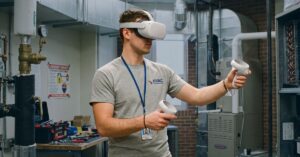
Offer online, on-demand training programs that incorporate both options. Hands-on 3D simulations and expert-led instructional videos ensure the optimal balance of information your technicians need. Immersive training techniques model real-world field scenarios, helping learners practice and perform tasks so they’re equipped to succeed when they go to the job site. This virtual approach helps users understand complex information like wiring diagrams, equations, and system configurations and charts—allowing them to practice troubleshooting, repairing, installing, and maintaining the equipment risk-free.
#3—Ensure Engagement and Participation
Technicians are the economic engine of your business. Increasing revenue and managing expenses hinges on their performance—underperformance, callbacks, and poor customer satisfaction can all be related to technicians’ skill levels and training. But ensuring that employees are engaged and participating in training programs can be challenging, especially long-term.
Even the best training is only effective at providing the skills, standardization, and benefits needed if implemented correctly and employees are interested in using it. If employees view training as a low priority or resist change, your training program doesn’t stand a chance.
Create a culture that values learning and development to encourage participation in training programs. Increased participation and ongoing engagement starts with the “why.” Make a clear use case that outlines why to increase user buy-in and give you the most return on your training investment. Conveying the why also promotes a meaningful (and positive) work environment, growth opportunities, and increased trust in leadership.
You can also incentivize your training or assign specific times for your technicians to train. Companies that require training have the highest adoption, most engaged techs, and highest return on investment (ROI). But “required training” doesn’t have to mean the “same,” or feel boring. Host employee contests and award prizes to the winners, or offer incentives like gift cards and free lunches when specific levels of training or goals are reached.
#4—Measure Training Effectiveness
Without effective means to measure, you have no way of understanding how your training investment has made an impact. And without data to analyze performance, your employees may become bored or disengaged.
To build a skilled workforce for the future and leverage their capabilities, you must take a human-centered approach to building the employee experience. This starts by demonstrating to employees you value them by recognizing their achievements. But measuring the impact of training in its entirety can be a challenge—even more so regarding specific employee performance, productivity, and business outcomes.
Use digital solutions like dashboards and analytics tools to view the performance of all workers. These tools enable you to explore your team’s usage and progress for a selected time—including user engagement, top user, and course progress—and export progress reports. This offers valuable insight into training comprehension and progress, increasing your technician engagement and training effectiveness exponentially.
While often overlooked, training is no different than any other investment your business makes, and you want to see that money spent developing employees is paying off. Measure business outcomes by focusing on several metrics: increased efficiency and performance, improved customer satisfaction, higher employee morale and engagement, competitive edge, and improved safety.
#5—Manage Industry Changes and Meet Regulatory Requirements
Workplace safety is an essential concern for any business. Not only does it protect employees from injury, but it also helps improve productivity and reduce liability risks. HVAC technicians are no exception and must meet regulatory requirements to perform their jobs legally and safely.
Regulatory requirements vary depending on the location—requiring HVAC trainers to stay up-to-date with the latest regulations to ensure their trainees are prepared for the job. But developing and maintaining a comprehensive training program that supports a safe work environment can be challenging (and expensive.)
Offer convenient and cost-effective ways to give your employees the skills they need to work safely. Regular safety training goes a long way in getting technicians up to date, but you need training that is engaging and continually refreshed and updated.
Safety training—like Interplay’s OSHA 10-hour training, EPA 608, and NATE HVAC Skilled Trade Certifications—improve productivity and reduce risk at a cost-efficient level. Interplay offers one-stop-shopping for safety training and award-winning, hands-on skilled trades training.
Interplay also helps you keep technicians up-to-date by offering continuing education credits (CEUs), allowing them to earn while they learn. With IACET accreditation, learners can qualify for annual CEUs by state licensures or various credentialing bodies.
With training from Interplay, you can start building a culture of safety and provide your workers with the knowledge they need to reduce incidents, remain safe, and ultimately improve the bottom line.
There’s no question your company wants to make money, but training shouldn’t be a rushed process. Team members needing more technical training and knowledge create a systematic solution. If you want to build your business, make more money, and retain top talent, it starts with being intentional with your training. Skill up with the leading global online and VR training provider for the essential skilled trades.
Schedule time with a training consultant to learn how to make online skilled trades training faster, better, and more accessible.
Latest

Boosting Your Bottom Line: How to Maximize Training ROI

Why Gen Z Learners Need a Different Approach to Trades Education

5 Ways to Navigate the Teacher Shortage with Technology
6 Building Blocks Your Trades Program Needs to Win Funding, Improve Delivery, and Increase Access
Text
Bigger text
Line height
Text align
Readable font
Visual
Contrast
Grayscale
Hide images
Pause animations
Orientation
Screen reader
Highlight links
Reading mask
Outline focus
Sitemap
Page structure
We use cookies
We use cookies to improve your experience on this website. You may choose which types of cookies to allow and change your preferences at any time. Disabling cookies may impact your experience on this website. You can learn more by viewing our Cookie Policy.
Do Not Sell or Share My Personal Information

Qualified