
Teacher Burnout Solutions: Technology as a Tool
The article discusses how widespread teacher burnout—exacerbated by post-pandemic challenges, social pressures, and mental health concerns—affects nearly half of K–12 educators in the U.S., contributing to workforce shortages, and emphasizes that technology can serve as a practical tool to help recognize, alleviate, and manage this burnout to improve teacher well-being and retention.
Technology as a Tool to Help Combat Teacher Burnout
-
July 25, 2023
-
 by
Interplay Learning
by
Interplay Learning

Teachers bear the burden of criticism in the modern era of social media. They face challenges and pressures from administrators, parents, students, and the public. The post-pandemic world exacerbated these challenges while adding student mental and physical health as a concern.
There’s no wonder burnout is so prevalent in education. In the United States, 44% of teachers in K–12 education said they very often or always feel burned out at work—35% for college or university teachers, according to the Gallup Panel Workforce Study conducted in February 2022 with 12,319 U.S. full-time employees (including 1,263 K–12 workers.)
Burnout levels are leading to a workforce shortage of professionals, especially teachers. Despite these grim findings, Gallup research confirms that burnout can be temporary, and leaders can alleviate it, even in challenging environments.
What is Burnout?
Burnout is more than feeling stressed. Job-related burnout is a type of work-related stress that includes a state of physical or emotional exhaustion that also involves a sense of reduced accomplishment and loss of personal identity. Being “burned out” isn’t a medical diagnosis, but some experts agree that underlying conditions (like depression) can lead to burnout.
Recognizing burnout early is essential because if left undetected, it affects employee morale, health, and well-being. It isn’t only bad for health—burnout leads to lower productivity, increased absenteeism, and even job loss. But what may be even more concerning is its impact on student success.
According to an article published by the International Journal of Educational Research in ScienceDirect, high-stress levels make teachers feel less effective, directly impacting their instruction, classroom management, and relationships with students. In the same study, only 12% of teachers say they are satisfied with their roles.
Tools for Mitigating Burnout
Too often, administrators respond to burnout by offering superficial solutions that don’t solve teacher problems. Instead, administrators should build an atmosphere that retains teachers. So what can schools and districts do to increase teacher retention and help avoid burnout? It’s not all about appreciation, compensation, and workplace culture—providing adequate resources is a top priority for burnout prevention.
Technology is one tool to help combat teacher burnout.
When implemented in schools, technology can support teachers and staff and reduce burnout by streamlining instruction, alleviating tedious tasks, and improving student engagement.
Additionally, technology helps teachers offer more engaging and inspiring tools, eliminate costs, and ensure a safe learning environment. This is especially true in skilled trades courses where risk is increased but also consumables and equipment equate to high program costs—requiring more critical resources to support student success.
Streamline Instruction
With its constant evolution, technology continues to push classrooms forward. The availability of technology tools in the classroom prevents burnout by assisting teachers and enhancing the learning experience. Most notably, technology streamlines instruction by saving time on lesson planning, increasing organization, and integrating with other platforms.
Interplay Learning’s simulation-based learning platform is built specifically for instruction and helps take teaching to the next level without adding additional work for teachers. Lesson planning is no easy task, but with Interplay Learning, teachers can quickly identify the content and simulations that align with their existing curriculum. This virtual teaching aid helps students become familiar with the foundational concepts, and enables teachers to focus their class time and energy on what really counts, practical application.
Shawn McGivern, a third-generation trades educator at Kansas City Community College explains how Interplay Learning makes instruction more efficient. “I always wanted more visuals because people learn so many ways—the visual aid and interaction of Interplay are great,” McGivern said. “I don’t have to take up class time to teach something that Interplay covers. I can track their assignment progress on Blackboard, saving me hours every week.”
Alleviate Tedious Tasks
Technology mitigates the burdensome logistical barriers that drive teacher fatigue and frustration. It can reduce time spent on administrative work by bringing instructional content and lesson plans into one consolidated platform.
EdTech tools like Interplay Learning can integrate into existing LMS solutions or provide teachers with their own user-friendly dashboard where they can easily assign homework, track student progress, and assess students’ skill sets. Eliminating tedious administrative tasks gives teachers more time back in their day.
Improve Student Engagement and Retention
Teachers of skilled trades courses are responsible for delivering engaging instruction and ensuring the safety of students. But without adequate resources or practice time, students are often timid and unprepared to handle actual equipment—leading to potentially dangerous situations. By giving students virtual environments to train in, teachers can feel confident that every student is receiving the hands-on practice they need to succeed in both a cost-effective and safe environment.
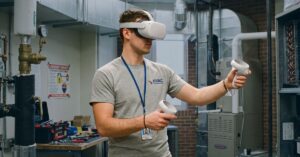
Interplay Learning’s immersive 3D and VR simulations allow students to practice as often as needed in a safe virtual environment. These simulations create an easy way for teachers to offer interactive activities that keep students focused and engaged in learning. And because these simulation courses are expert-led and completed independently, they can be assigned as homework to better prepare students for classroom discussions and labs. Teachers have peace of mind that students are getting enough practice to build their confidence and get prepared for real-world scendarios.
DJ Mumau, HVAC Instructor at Indiana County Technology Center (ICTC), integrated Interplay’s simulation courses into the curriculum and almost immediately noticed the accelerated student ability to work with specialty tools and live HVAC/R equipment in the lab. “I can teach a lesson in the classroom or do a lab demonstration and then assign the corresponding Interplay course where they can see the same concepts visually, through images, videos, or diagrams,” Mumau said. “Students come into the shop and apply the lesson hands-on.”
As a result of using Interplay Learning’s simulation courses, ICTC noticed decreased lab equipment damages and material costs and increased student retention, post-grad exam performance, and job placements.
When teachers are resigning or can’t work because of burnout, your school suffers. You need teachers to be performing at their best. To learn more about how you can take proactive steps to prevent burnout with the use of technology, read more about Interplay Learning’s Education Solution here.
Latest

Boosting Your Bottom Line: How to Maximize Training ROI

Why Gen Z Learners Need a Different Approach to Trades Education

5 Ways to Navigate the Teacher Shortage with Technology
6 Building Blocks Your Trades Program Needs to Win Funding, Improve Delivery, and Increase Access
Text
Bigger text
Line height
Text align
Readable font
Visual
Contrast
Grayscale
Hide images
Pause animations
Orientation
Screen reader
Highlight links
Reading mask
Outline focus
Sitemap
Page structure
Qualified