
3 Funding Sources To Support School Initiatives
The article outlines three key funding sources—federal, state, and local funds—that educators and school leaders can leverage to support innovative educational initiatives, such as implementing digital learning tools like Interplay Learning’s immersive 3D and virtual reality skilled trades courses.
3 Funding Sources That Can Support Your School’s Initiatives
-
March 28, 2023
-
 by
Interplay Learning
by
Interplay Learning

As we move towards an ever-evolving educational landscape, investing in innovative learning solutions becomes more crucial. However, finding the right funding options to support these solutions can be challenging for educators, administrators, and school district leaders alike. Luckily, there are a variety of federal, state, and local funding options available that can help support your school’s initiatives.
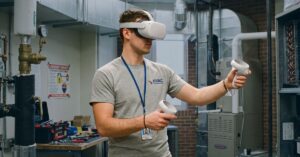
In this blog, we will explore three funding options you could utilize to support the implementation of digital learning resources, such as Interplay Learning’s immersive 3D and virtual reality skilled trades courses.
Experience 3D Sim Training in Action
Submit the form to get in touch with a representative.
Email*
First name*
Last name*
Organization name*
Phone number*
Job title*
How many learners does your organization have?*
Please Select12-1415-2425-250251+
Latest UTM Source
Latest UTM Medium
Latest UTM Campaign
Latest UTM Content
Latest UTM Term
GCLID
Latest Conversion Activity (Inbound vs Outbound)
Demo Conversion Activity (Inbound vs Outbound)
Federal Funds
Federal education funds are monetary resources provided by the federal government to support education at the local, state, and national levels. These funds are typically allocated to support specific initiatives, programs, or policies aimed at improving the quality of education for all students.
Interplay’s simulation-based solution is eligible for various federal funding options, including Elementary and Secondary School Emergency Relief Funds (ESSER) and the Carl D. Perkins Career and Technical Education Act (Perkins V).
The Elementary and Secondary School Emergency Relief (ESSER)
The ESSER fund is a federal education funding program established under the Coronavirus Aid, Relief, and Economic Security (CARES) Act in 2020. The purpose of the ESSER Fund is to provide emergency relief funding to states and school districts to address the impact of the COVID-19 pandemic on elementary and secondary schools.
Carl D. Perkins Career and Technical Education Act
Perkins V funding is a type of federal education funding that is aimed at improving career and technical education (CTE) programs in high schools and community colleges. The purpose of Perkins V funding is to provide students with the skills and knowledge they need to succeed in high-demand, high-wage careers. This is achieved by supporting the development of high-quality CTE programs that are aligned with the needs of local employers and industries.
State Funds
In addition to federal funds, you may be able to use state funding options to purchase Interplay Learning’s simulation-based learning platform. State education funding refers to the funding that states provide to their K-12 public schools, colleges, and universities.
These funds are then distributed to local school districts and higher education institutions based on a variety of factors, including enrollment, student demographics, and local tax revenues.
Interplay’s training solution is eligible for state funding in various states across the US. Click on the state you reside in to learn more about the funding options available in your location.
| Alabama <br>Alaska<br>Arizona<br>Arkansas<br>California<br>Colorado<br>Connecticut<br>Delaware<br>Florida<br>Georgia | Hawaii <br>Idaho<br>Illinois<br>Indiana<br>Iowa<br>Kansas<br>Kentucky<br>Louisiana<br>Maine<br>Maryland | Massachusetts <br>Michigan<br>Minnesota<br>Mississippi<br>Missouri<br>Montana<br>Nebraska<br>Nevada<br>New Hampshire<br>New Jersey | New Mexico <br>New York<br>North Carolina<br>North Dakota<br>Ohio<br>Oklahoma<br>Oregon<br>Pennsylvania<br>Rhode Island<br>South Carolina | South Dakota <br>Tennessee<br>Texas<br>Utah<br>Vermont<br>Virginia<br>Washington<br>West Virginia<br>Wisconsin<br>Wyoming |
Local Funds
Local education funding sources refer to the funds that are generated at the local level and are used to support schools in a particular community or region.
Interplay’s solution may also be eligible for local funds, including technology funds and school bonds. Check the local funding sources available to you to see how you can take advantage of available funds.
Make the Most Out of Your Available Funding
Investing in effective digital learning solutions like Interplay Learning’s immersive 3D and virtual reality skilled trades courses can help prepare students for success in their careers. With federal, state, and local funding options available, now is the time to invest in the future of education. Explore the funding options available to you and start investing in your students’ futures today.
\\\__________
* Note: The information provided above represents some, but not all, possible funding sources that can be used to purchase Interplay Learning’s innovative training solution. It is the responsibility of the purchaser to secure funding.
Latest

Boosting Your Bottom Line: How to Maximize Training ROI

Why Gen Z Learners Need a Different Approach to Trades Education

5 Ways to Navigate the Teacher Shortage with Technology
6 Building Blocks Your Trades Program Needs to Win Funding, Improve Delivery, and Increase Access
Qualified