
Metrics that Matter: A Quick Guide to Measuring Training ROI
The guide "Metrics that Matter: A Quick Guide to Measuring Training ROI" emphasizes the importance of tracking key metrics—operational impact, engagement and retention, and financial and leadership outcomes—to demonstrate how training in industrial and facilities environments drives business value by improving performance, safety, reliability, and employee retention.


Metrics that Matter
A Quick Guide to Measuring Training ROI
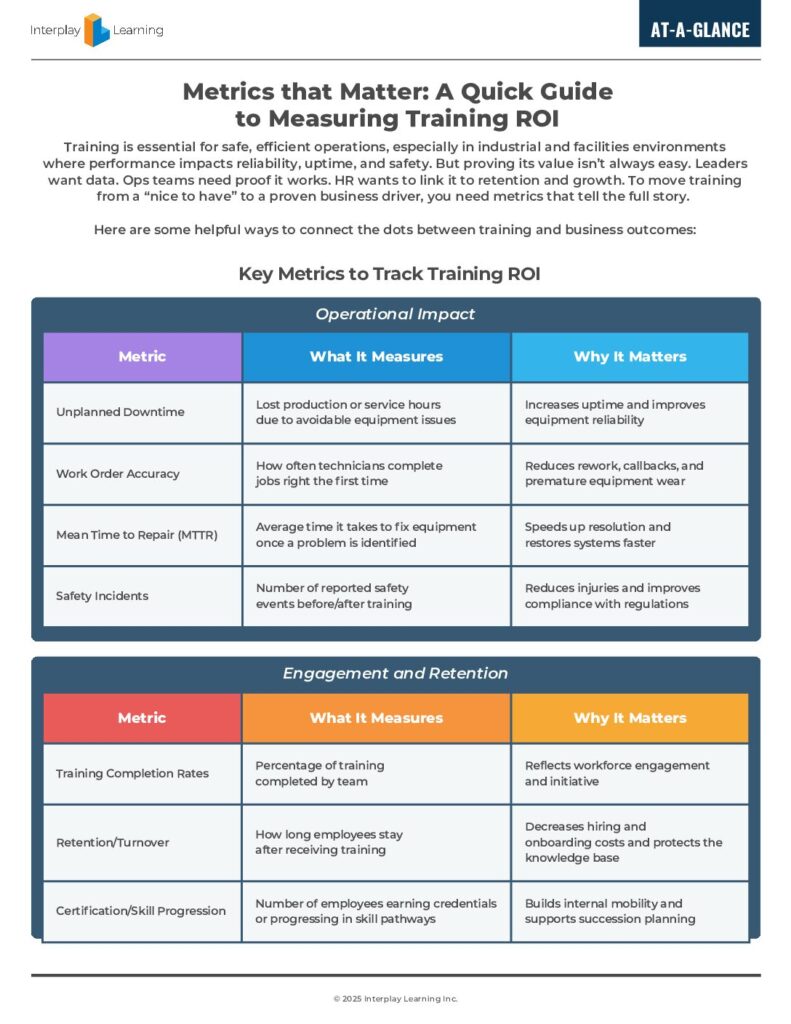
Key Metrics to Track Training ROI
Operational Impact
Engagement & Retention
Financial & Leadership
Operational Impact
Engagement & Retention
Financial & Leadership
Operational Impact
Engagement & Retention
Financial & Leadership

From “Nice to Have” to Business Driver
Training is essential for safe, efficient operations, especially in industrial and facilities environments where performance impacts reliability, uptime, and safety. But proving its value isn’t always easy. Leaders want data. Ops teams need proof it works. HR wants to link it to retention and growth. To move training from a “nice to have” to a proven business driver, you need metrics that tell the full story.

Operational Impact
These metrics show how training directly improves performance, reliability, and safety across your facilities and industrial operations:
- Unplanned Downtime – Tracks lost production or service hours due to avoidable equipment issues. Lower downtime means greater uptime and equipment reliability.
- Work Order Accuracy – Measures how often technicians get the job right the first time. Higher accuracy reduces rework, callbacks, and premature equipment wear.
- Mean Time to Repair (MTTR) – Calculates the average time it takes to fix equipment after an issue is identified. Lower MTTR speeds up resolution and restores systems faster.
- Safety Incidents – Tracks reported safety events before and after training. Fewer incidents protect employees and improve regulatory compliance.
Engagement & Retention
Training also impacts workforce stability and development. These metrics connect learning to long-term employee value:
- Training Completion Rates – Percentage of training completed by your team. A higher rate reflects strong workforce engagement and initiative.
- Retention/Turnover – How long employees stay after receiving training. Lower turnover reduces hiring and onboarding costs while protecting institutional knowledge.
- Certification & Skill Progression – Tracks employees earning credentials or progressing in skill pathways. This supports succession planning and builds internal
Financial & Leadership
Beyond operations and workforce engagement, training also drives measurable business outcomes that leaders care about. These metrics tie learning directly to cost savings, efficiency, and leadership bandwidth:
-
Time to Productivity – The ramp-up time for new hires to perform work independently. Faster productivity shortens payback periods.
-
Supervisor Time Spent Training – Hours senior techs spend onboarding or retraining others. Reducing this time reclaims expert bandwidth and lessens knowledge drain.
Discover Why Metrics Matter in Measuring ROI with Interplay Learning
Schedule Time with a Training Expert to Learn More.
Qualified
Simone, AI Agent
Simone Your Learning Advisor

Speak now
Hi, I'm Simone from Interplay Learning. Our immersive training solutions help organizations measure and improve training ROI with real outcomes like safer work and better performance. What training goals are you focusing on to boost your team's readiness?
Conversation
Hi, I'm Simone from Interplay Learning. Our immersive training solutions help organizations measure and improve training ROI with real outcomes like safer work and better performance. What training goals are you focusing on to boost your team's readiness?
Message input
Book a Meeting
Message Simone
This conversation may be recorded and used per our Privacy Policy
Ask Simone